

Our Practice
We are a spatial planning firm.
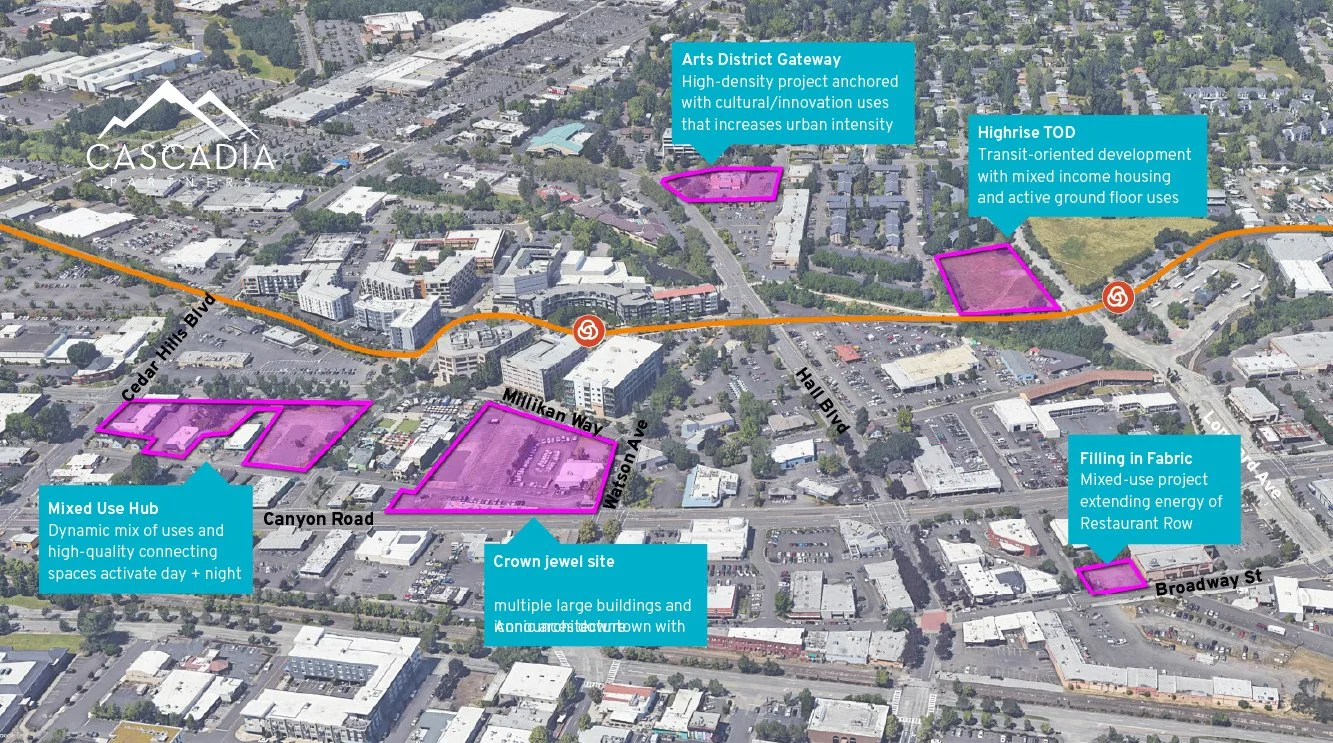
What Is Spatial Planning?
Every planning problem has a spatial dimension — and this is our focus. Where housing goes shapes who can afford to live there. How a street is designed determines whether a neighborhood feels like a safe place to walk. What a zoning code permits sets the ceiling on what gets built. Spatial planning treats the physical environment as the operating system for equity, sustainability, and economic life — and anchors every analysis, plan, and recommendation to it.
See spatial planning in practice.

Spatial planning only works when every discipline that shapes a place sits at the same table.
That’s why Cascadia is vertically integrated by design: planners, economists, urban designers, policy writers, and engagement specialists work as one team — so pro forma findings shape code drafts, design ideas get stress-tested against market reality, and community input loops back into the analysis. One team carries a project from vision through implementation.
Our Values
Three commitments, inseparable in practice. Equity grounds the work, sustainability keeps it durable, and pragmatism turns both into plans that get funded, adopted, and built. Balancing what matters with what works, we hold every project to all three at once.
-
Planning decisions have long concentrated resources and influence in some communities while leaving others out. We treat equity as an operational discipline: compensating community members for their time, partnering with trusted local organizations to reach underserved and underrepresented populations, and writing recommendations that address displacement and exclusion rather than just describe them. An inclusive process is what makes equitable outcomes possible.
-
How we grow and get around is a primary driver of climate impact. Our scenario planning and development policy work helps communities grow into compact, walkable, mixed-use, mixed-income neighborhoods — curbing sprawl and the loss of surrounding farm and natural lands. Our environment and climate work — urban forestry, tree-canopy equity, climate action plans, and natural-lands planning — weaves nature through the city and broadens equitable access to it. We believe cities and towns can be dynamic, livable places that are also equitable, low-impact, and resilient.
-
We’re driven by a vision of equitable, sustainable places — and clear-sighted about the obstacles to reaching them. We harness market realities for good: using economic rigor to make equitable, sustainable outcomes financially real, not just aspirational. Our plans, codes, and strategies are written for adoption and execution — market feasibility tested with pro forma, codes drafted with the development review process in mind. Successful city-building needs public and private actors working together, which is why we calibrate solutions to what will actually move forward. And because change rarely happens all at once, we plan for it in stages — maximizing wins in the short term and building toward catalytic change over time.
How our values shape our work
Equity, sustainability, and pragmatism aren’t abstractions — they shape concrete choices across the firm.
Our Operations
Who we hire, and who leads
How we make decisions
How we reduce our own environmental footprint
How we invest in our team’s growth and balance
Our Practice
How and who we engage
How we evaluate and analyze
Who benefits from our recommendations
How we structure project teams
Our Projects
The work we pursue
The clients we take on
Who we team with
The communities where we work